
Juan Pesina
Happy Client

A crash with a commercial truck can upend a family’s life in seconds, and the questions that follow, about bills, work, and who is responsible, rarely have simple answers. Hines Law Firm’s Georgia truck accident lawyers represent people injured by tractor-trailers, box trucks, and other commercial vehicles across the state. We focus on the federal rules the trucking company had to follow, every company that may share responsibility, and the records that can disappear if no one asks for them in time.
Our attorneys serve truck crash victims from offices in Atlanta, Austell, Dalton, Fayetteville, Gainesville, Marietta, and Norcross, and we work with clients in English and Spanish. The consultation is free, and there is no attorney fee unless we recover compensation for you.
Call Hines Law Firm any time, day or night, to talk with a truck accident lawyer about what happened.
Our highly experienced lawyers will contact you for a Free Legal Consultation.
"*" indicates required fields
Most commercial trucks on Georgia highways must follow the Federal Motor Carrier Safety Regulations, a detailed set of rules covering drivers, vehicles, insurance, and record-keeping. Trucks that operate only inside Georgia are regulated through the Georgia Department of Public Safety, which adopts most of the same federal standards for in-state carriers.
The table below shows the parts of the federal rules that come up most often in Georgia truck accident claims:
| Federal rule | What it covers | Why it matters in a claim |
|---|---|---|
| Part 382 | Drug and alcohol testing | Shows whether the driver was tested before hire, at random, and after the crash |
| Part 383 | Commercial driver’s licenses | Shows whether the driver was licensed for the vehicle and cargo |
| Part 387 | Minimum insurance | Sets the floor for the liability coverage available |
| Part 391 | Driver qualification | Shows what the carrier knew about the driver’s history and health |
| Part 392 | Driving rules | Covers fatigue, phone use, and driving in hazardous conditions |
| Part 393 | Equipment and cargo | Covers brakes, lights, rear guards, and load securement |
| Part 395 | Hours of service | Limits driving time and requires electronic logging |
| Part 396 | Inspection and maintenance | Requires inspections, repairs, and driver vehicle inspection reports |
A violation of these rules does not automatically decide a case on its own, but it can be strong evidence that a driver or carrier failed to act with reasonable care. The full text is available through the Federal Motor Carrier Safety Administration, and the records each part requires are often the most valuable evidence in a claim.
Federal rules set higher minimum insurance levels for trucks hauling oil and hazardous materials than for general freight. A tanker or placarded truck crash can also involve spill response, evacuation, and cleanup issues, so identifying the cargo early helps show which rules and coverage apply.
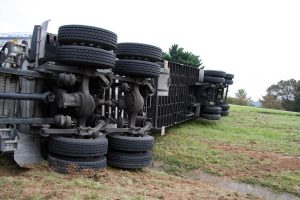
Truck accident claims in Georgia often involve several defendants because the people and companies behind a truck are spread across different businesses. Identifying each one early affects how fault is divided and how much insurance coverage is available. Each company may also have its own insurer and its own lawyers, which can make these cases move differently from a typical car accident claim.
The motor carrier is generally responsible for its driver’s conduct on the job. Georgia law also allows separate claims that the carrier was negligent in hiring, training, supervising, or keeping an unsafe driver, which focus on the company’s own decisions rather than only the driver’s.
The owner of a leased tractor, the company that loaded the trailer, and the business that maintained the brakes can each share responsibility when their mistakes contributed to a crash. Claims against freight brokers face a significant legal hurdle in Georgia, because a federal appeals court covering the state has held that many negligent-selection claims against brokers are preempted by federal law.
Under O.C.G.A. § 51-12-33, a jury assigns a percentage of fault to each party, and defendants generally pay only their own share. Fault can even be assigned to someone who is not a party to the lawsuit, which is why leaving out a responsible company can reduce what the injured person recovers. Defendants often point to one another, and the evidence has to show how each one contributed.
For many years, Georgia allowed injured people to name a motor carrier’s insurer directly in the lawsuit. A 2024 change limits that to situations such as a carrier’s insolvency or bankruptcy, or when the carrier or driver cannot be served, for crashes on or after July 1, 2024, so the case now focuses more heavily on the carrier and the driver themselves.
“Thank you all for the help during the time of uncertainty , very attentive and very professional group of individuals especially Julian who is a very great part of the team. Took time out of his day to reach out to you either through email or phone call. Your questions will be answered. Thank you all for the great help. 🙏🏽”

“They are a team of very responsible, kind and dedicated professionals, they were always aware of all the details of the case and keeping us informed about each step we should take, I recommend them 100% Thanks so much, Great job”
“They are an excellent team, they always attended to all my concerns, defending my rights and representing me throughout the process. they always made me feel calm and trusting of them. I highly recommend them. They met all my expectations.”
“Helped me so much during my accident. I recommend this firm to everyone I know and meet they’re just that amazing and I love that their team is bilingual!!”
A preservation letter puts the trucking company and other companies on notice that they must keep evidence about the crash. In Georgia, the Supreme Court held in Phillips v. Harmon that the duty to preserve evidence arises once a party reasonably anticipates litigation, and a clear written notice from the injured person is one of the most direct ways to trigger that duty.
Federal rules set minimum retention periods for many trucking records, and some are surprisingly short. Hours-of-service records, for example, generally must be kept for only six months. Once those periods pass, a company may discard records in the normal course of business unless it has been told to keep them.
| Record | General federal retention period |
|---|---|
| Hours-of-service records and supporting documents | Six months |
| Driver vehicle inspection reports | Three months |
| Inspection, repair, and maintenance records | One year at the carrier, and six months after the vehicle leaves its control |
| Driver qualification file | The length of employment plus three years |
| Negative drug and alcohol test results | One year |
| Positive test results and refusals | Five years |
| Accident register | Three years |
Some of the most important evidence has no federal retention rule at all. Engine control module data, dashcam footage, and dispatch messages can be overwritten as the truck keeps operating, which is why preservation requests should go out as soon as possible.
Ideally, a preservation letter goes out within days of the crash, before the truck returns to service or is repaired. Separate letters may be needed for the carrier, the truck’s owner, the shipper, and any repair shop or towing company holding the vehicle.
A preservation letter should be specific about the records, devices, and companies involved. A general request may leave room for a company to argue it didn’t know what to keep, so the letter should name the truck, the date, and the categories of records.
Requests in a Georgia truck case often cover:
When evidence is destroyed after the duty to preserve arises, Georgia courts can impose sanctions, including instructing the jury that the missing evidence would have hurt the company that destroyed it. That remedy is far less useful than the evidence itself, which is why acting early matters.

Georgia’s statutes and court rules set the deadlines and procedures that apply to every truck accident claim in the state. Knowing them early helps avoid mistakes that can’t be fixed later.
Most Georgia personal injury lawsuits must be filed within two years of the crash under O.C.G.A. § 9-3-33, and property damage claims generally have four years. Exceptions can change these periods, so the deadline for a specific case should be confirmed early. Claims involving a government vehicle carry much shorter notice deadlines.
Georgia allows an injured person to recover as long as they are less than 50% at fault, with the award reduced by their share. Trucking companies often argue that the other driver contributed to the crash, which makes early, independent evidence about how it happened especially valuable. Engine data, video, and witness accounts often answer that argument more clearly than either driver’s memory.
Georgia’s 2025 tort reform law changed how injury and wrongful death cases are tried. Either side can now ask the court to decide fault and damages in separate phases, arguments about the dollar value of pain and suffering are more limited, and evidence of medical expenses now focuses on amounts actually paid or owed for claims arising after April 21, 2025.
Hines Law Firm has represented injured Georgians since Matthew C. Hines founded the firm in 2004. Our offices put us close to the interstates and freight corridors where these crashes happen, from I-75 in Dalton and Marietta to I-20 in Austell and I-985 in Gainesville. Wherever the crash happened, the same team approach applies.
When you work with us, you get:
No lawyer can promise a particular result, but we can give you an honest assessment of your claim. Call Hines Law Firm today to speak with a Georgia truck accident lawyer.
Here are answers to other questions people ask after a truck crash in Georgia.
No. A Georgia truck accident lawyer can handle a claim for a crash anywhere in the state, and the lawsuit may be filed in a county other than where the crash occurred. Hines Law Firm meets with clients at offices across Georgia.
Claims against a city, county, or state agency in Georgia follow special rules, including written notice deadlines that can be as short as six months for a city and 12 months for a county or the state. Government immunity can also limit what is recoverable, so these cases need prompt attention.
Hours-of-service records are not public, but they can be obtained through a preservation request and the discovery process once a claim is underway. Those records can then be compared with fuel receipts and delivery times. Because carriers generally must keep those records for only six months, requesting them early is important.
It can. For claims arising on or after April 21, 2025, Georgia law allows evidence of whether an injured person was wearing a seat belt to be considered in deciding fault and damages, which was not allowed before.
You can still bring a claim. The motor carrier generally remains responsible for its driver’s conduct on the job, and a claim can also be brought against the driver’s estate, though the process involves additional steps. Insurance coverage for the truck usually remains in place regardless of what happened to the driver.
The trucking company’s team starts protecting its records and its story right after a crash. Call Hines Law Firm any time to schedule a free consultation in English or Spanish, and we will explain your options and the steps that can protect your claim.
Results depend on the specific facts of each case. This page provides general information about Georgia law and is not legal advice.
Hines Law 1100 Circle 75 Pkwy SE, Suite 1200, Atlanta, GA 30339
Hines Law 5000 Austell-Powder Springs Road, Suite 282 Austell, GA 30106
Hines Law 175 John W. Morrow Junior Pkwy Gainesville, GA 30501
Hines Law 2190 N Norcross Tucker Rd Suite 104A, Norcross, GA 30071