
Juan Pesina
Happy Client

A crash with a tractor-trailer or delivery truck can leave you hurt, out of work, and facing an insurance company that moved faster than you did. Hines Law Firm’s Gainesville truck accident lawyers represent people injured by commercial vehicles across Hall County and North Georgia. We start by finding out which rules the truck and its driver had to follow, because that answer shapes who is responsible and how your claim is built.
Freight around Gainesville looks different from freight in downtown Atlanta. Live poultry haulers, feed trucks, refrigerated food trailers, and plant delivery routes share I-985, U.S. 129, and the roads around the processing plants, and some of those trucks operate under exemptions that change which records exist.
If a commercial truck hits you or someone you love in the Gainesville area, call our Gainesville office for a free consultation in English or Spanish. We take calls 24/7.
Our highly experienced lawyers will contact you for a Free Legal Consultation.
"*" indicates required fields
The type of truck and what it was hauling decide which safety rules applied, which records the company had to keep, and who may share responsibility. A live poultry hauler, a refrigerated food trailer, and a local box truck can each fall under a different set of requirements.
Here is how common Gainesville-area freight tends to line up:
| Vehicle and load | Who usually operates it | Rules and records to look for |
|---|---|---|
| Live poultry or livestock haulers | Growers, poultry companies, or contract carriers | A possible agricultural hours-of-service exemption, bills of lading showing the load’s source, and driver qualification files |
| Feed and grain trucks | Feed mills and agricultural carriers | Agricultural exemption questions, inspection and maintenance records, and load weights |
| Refrigerated trailers carrying processed or packaged food | Food processors, distributors, and interstate carriers | Usually standard hours-of-service limits, electronic logging device data, and dispatch records |
| Box trucks and local delivery vehicles | Distributors, retailers, and leasing companies | Whether the vehicle meets commercial weight thresholds, lease agreements, and company driving policies |
Identifying the right category early tells us which records to request first and which companies may be involved beyond the driver. It also helps explain gaps in the records that an insurer might otherwise present as normal, such as missing driving logs for an exempt route.
Not always. Federal rules exempt drivers hauling agricultural commodities, including live poultry, from hours-of-service limits while they stay within 150 air miles of the load’s source during the planting and harvesting periods each state sets. Once the truck travels past that radius, the normal limits apply again.
The exemption covers driving-time limits, not the rest of trucking safety law. Licensing, vehicle inspection, and maintenance rules still apply, and federal rules still bar anyone from driving while too fatigued or ill to operate safely.
Companies sometimes point to the exemption to explain long hours behind the wheel. A fatigued driver can still be negligent, though, and bills of lading, plant departure times, and fuel receipts often show whether the truck was really inside the 150-air-mile radius when the crash happened.
“Thank you all for the help during the time of uncertainty , very attentive and very professional group of individuals especially Julian who is a very great part of the team. Took time out of his day to reach out to you either through email or phone call. Your questions will be answered. Thank you all for the great help. 🙏🏽”

“They are a team of very responsible, kind and dedicated professionals, they were always aware of all the details of the case and keeping us informed about each step we should take, I recommend them 100% Thanks so much, Great job”
“They are an excellent team, they always attended to all my concerns, defending my rights and representing me throughout the process. they always made me feel calm and trusting of them. I highly recommend them. They met all my expectations.”
“Helped me so much during my accident. I recommend this firm to everyone I know and meet they’re just that amazing and I love that their team is bilingual!!”
A truck that crosses state lines, or carries freight that is part of an interstate trip, generally falls under the Federal Motor Carrier Safety Regulations. Trucks that operate only inside Georgia are regulated through the Georgia Department of Public Safety, which adopts most federal safety rules with some differences for in-state carriers.
Interstate commercial trucks must display a USDOT number on the vehicle. That number can be looked up in the Federal Motor Carrier Safety Administration’s (FMCSA) public SAFER system, which shows the registered carrier and its inspection history, and it sometimes reveals that the company named on the trailer is not the one operating the truck.
Many trucks near Gainesville belong to private carriers: a poultry company, feed mill, or food distributor that hauls its own products. A private carrier is still responsible for its drivers’ conduct on the job, and it may also be responsible for its own hiring, training, and maintenance decisions. Those company records can matter as much as the driver’s own conduct.
Usually not anymore. Since a 2024 change to Georgia’s direct action statutes, a person hurt in a crash on or after July 1, 2024, can generally name the motor carrier’s insurance company as a defendant only if a carrier is insolvent or bankrupt, or if the driver or carrier cannot be served despite reasonable efforts.
For many years, Georgia allowed injured people to sue a trucking company and its insurer in the same lawsuit. Senate Bill 426 narrowed that right under O.C.G.A. §§ 40-1-112 and 40-2-140, but the carrier’s liability coverage still typically funds a settlement or judgment up to its limits, and crashes before July 1, 2024, fall under the earlier rules.
With the insurer usually out of the courtroom, the case focuses on the driver and the carrier themselves. That makes it more important to identify every responsible company, confirm each one’s correct legal name, and serve them properly from the start. Mistakes at this stage can delay a case for months, and they are much easier to avoid than to fix.

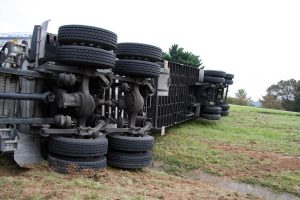
Many serious truck crashes around Gainesville involve a load that moved or a trailer that tipped, not just a driver who followed too closely. Tall poultry trailers, bulk feed tankers, and partially loaded reefers can become unstable on curves, ramps, and two-lane roads when they are loaded or driven carelessly.
Federal cargo securement rules require loads to be contained and secured so they can’t shift in a way that affects a truck’s stability. When a load breaks loose or slides, the question becomes who loaded it, who inspected it, and whether the driver was told about the weight and how it was distributed.
The company that loaded the trailer is not always the company that drove it. A plant or feed mill that overloaded a trailer or packed it unevenly may share responsibility with the carrier, which is why scale tickets and loading records matter so much in these cases.
In freight-heavy crashes around Gainesville, some of the most useful evidence sits with the plant, feed mill, or distributor, not only the trucking company. These records can show where a load started, how long the driver had been working, and whether the truck was carrying more weight than it should.
Records we look for in Hall County truck cases include:
Some of these records are kept for only a short time, so preservation requests should go out early. Companies that receive one have a duty to keep the evidence instead of discarding it in the normal course of business. When evidence is destroyed after that point, a court can respond with sanctions.
Most Gainesville truck claims begin with an investigation and an insurance claim, and many settle without a lawsuit. When a fair offer doesn’t come, the case can be filed in Hall County, where the State Court and the Superior Court of the Northeastern Judicial Circuit hear civil injury cases, or in another county where a defendant can be sued.
A typical path looks like this:
Georgia generally gives injured people two years from the crash to file a lawsuit under O.C.G.A. § 9-3-33, and claims involving a government vehicle require written notice much sooner. Exceptions can change these deadlines, and settling before your treatment is complete can leave future medical needs out of the claim.
Hines Law Firm has represented injured Georgians since Matthew C. Hines founded the firm in 2004, and our Gainesville office at 175 John W. Morrow Jr. Parkway keeps us close to the roads and courts where these cases unfold. Many of our Gainesville clients prefer to talk through their case in Spanish, and our team does that from the first call.
When you work with us, you get:
Every case is different, and no lawyer can promise a result. Call our Gainesville office for a free consultation about your truck accident claim, and we will explain what your case may involve before you make any decisions.
Here are answers to other questions people ask after a truck crash in the Gainesville area.
A poultry company, feed mill, or food distributor that runs its own trucks can be held responsible for a crash its driver causes while working, just like a for-hire trucking company. These private carriers also have to follow federal or state safety rules for commercial vehicles, depending on the truck and the trip.
Yes, in many cases. A worker hurt on the job in Georgia usually receives workers’ compensation benefits through the employer, and if a driver from an outside company caused the injury, the worker may also bring a separate personal injury claim against that driver and company.
Yes, as long as you are less than 50% at fault. Georgia’s comparative fault rule reduces your recovery by your share of fault, so a person found 20% at fault would recover 80% of their damages.
A Hall County truck accident claim can resolve in several months when fault is clear and treatment is finished, while a case that goes into litigation often takes a year or more. Serious injuries usually take longer, because a claim should not settle until future medical needs are understood.
A police report is not required to bring a truck accident claim in Georgia, but it is often one of the first documents an insurer reviews. If the report contains mistakes about how the crash happened, other evidence such as video, witness statements, and truck data can correct the record. You can usually request a copy of the report from the agency that responded to the crash.
Trucking companies and their insurers start building their side of the story right away. Call Hines Law Firm any time to schedule a free consultation in English or Spanish, and we will explain your options and what to do next.
Results depend on the specific facts of each case. This page provides general information about Georgia law and is not legal advice.